

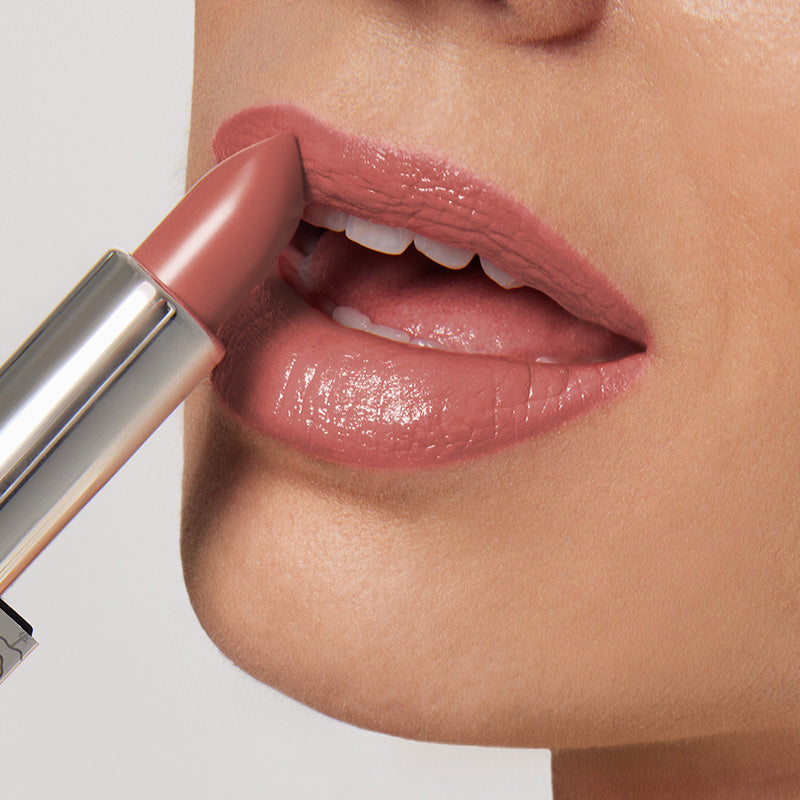
There are nine common lip shapes — full, thin, heart-shaped, bow-shaped, round, wide, top-heavy, bottom-heavy, and downturned. To identify yours, look at four things: overall volume, upper-to-lower ratio, width versus height, and how defined your cupid's bow is. Once you know your shape, you can choose lipstick techniques that work with your anatomy instead of against it.
Key takeaways
- Most people are a blend of two or three lip shapes — use the closest match as your starting point, not a rigid label.
- The four-factor method (volume, ratio, proportion, bow) identifies your shape in under a minute with no tools except a mirror.
- Every shape has lipstick techniques that flatter it and at least one common mistake that undermines it.
- Lip shape changes with age: the upper lip thins, the cupid's bow softens, and corners can drop — all of which respond well to targeted liner and hydrating formulas.
- Overlining works when it stays under 1 mm and follows the natural curve; more than that reads as unnatural in person, regardless of how it photographs.
- A clear invisible lip liner is the single most versatile tool for every lip shape because it prevents feathering without adding colour.
How do you identify your lip shape?
Stand in front of a well-lit mirror with bare lips in a relaxed, closed-mouth position. Evaluate four features, in this order:
1. Volume. Look at your lips from the front. Are they naturally plump and prominent, narrow and understated, or somewhere between? This tells you whether you are working with a full, thin, or medium-volume baseline.
2. Upper-to-lower ratio. Compare the thickness of your upper lip to your lower lip. If they are roughly equal, your shape is balanced. If one is noticeably fuller than the other, you have either a top-heavy or bottom-heavy shape — and this single observation determines most of your technique adjustments.
3. Width versus height. Are your lips wider than they are tall, creating a horizontal stretch? Or are they closer to equal in both dimensions, creating a rounder shape? Wide lips extend past the iris line when you look straight ahead; round lips sit within it.
4. Cupid's bow definition. Look at the centre of your upper lip. A sharp, peaked M-shape is a bow-shaped lip. A softer V-dip is heart-shaped. A gentle curve with no obvious peaks is round or full. And a barely visible line is common in thin or mature lips.
Score yourself on each factor and compare against the table below. Most people are a blend of two or three categories — that is completely normal, and the techniques still apply.
What are the nine most common lip shapes?
| Lip shape | Defining feature | Cupid's bow | Volume balance | Best technique at a glance |
|---|---|---|---|---|
| Full | Even plumpness on both lips | Moderate to pronounced | Balanced upper and lower | Apply colour directly from the bullet; skip overlining |
| Thin | Low volume on both lips | Often subtle or flat | Balanced but narrow | Overline ≤1 mm; place gloss at the centre for dimension |
| Heart-shaped | Full centre, tapered corners | Deep V-shape | Upper-heavy at centre | Follow the natural bow precisely; darker liner at outer edges |
| Bow-shaped | Sharp M-shaped upper lip | Very defined twin peaks | Variable | Highlight the peaks; apply lipstick with a brush for precision |
| Round | Equal width and height | Soft and subtle | Balanced, circular outline | Define edges with a liner one shade deeper than lipstick |
| Wide | Extends past the iris line | Variable | Horizontally stretched | Darker shade at corners, lighter at centre to draw the eye inward |
| Top-heavy | Upper lip fuller than lower | Variable | Upper-dominant | Slightly overline the lower lip; use a matte on top, gloss below |
| Bottom-heavy | Lower lip fuller than upper | Often subtle | Lower-dominant | Overline upper lip ≤1 mm; highlight the cupid's bow |
| Downturned | Corners angle downward | Variable | Balanced or lower-dominant | Lift corners with liner drawn slightly upward; avoid dark mattes |
Full lips
Full lips have even plumpness across both the upper and lower lip. They sit prominently on the face and hold strong colour well. Because the volume is already there, the main goal is definition, not enhancement.
How to spot them: Both lips look equally plump from a side profile. The pout is naturally visible without product.
Lipstick technique: Apply lipstick directly from the bullet, following your natural lip line. Bold colours and matte finishes work here because the volume supports them. Skip overlining — on full lips it reads as too much. For subtle contouring, line with a shade one step deeper than your lipstick and blend inward.
Thin lips
Thin lips have lower natural volume on both upper and lower lip. They look delicate and understated, and they are one of the easiest shapes to enhance with the right technique.
How to spot them: Both lips appear narrow with minimal vertical height. The lip line is often subtle.
Lipstick technique: Use a lip liner just outside your natural lip line — no more than 1 mm — and fill in with a lipstick one shade lighter than the liner. Place a dot of shimmery gloss at the centre of both lips to create the illusion of dimension. Avoid dark mattes, which make thin lips look thinner. Cream and satin finishes are more forgiving. Nikol Beauty's Crystal Clear Invisible Lip Liner is useful here because it creates the barrier for overlining without adding a visible colour edge.
Heart-shaped lips
Heart-shaped lips are fuller in the centre and taper gently toward the corners, with a pronounced V-dip in the upper lip. The shape reads as youthful and expressive.
How to spot them: The upper lip forms a clear heart. The lower lip is rounded and plump at the centre.
Lipstick technique: Follow your cupid's bow precisely with liner — this shape's appeal comes from its natural contour. Do not overdraw the corners, which flattens the taper. For evening, use a slightly darker liner along the outer third and a brighter lipstick at the centre to accentuate the heart shape.
Bow-shaped lips
Bow-shaped lips have a sharply defined M-shape on the upper lip — two clear peaks separated by a sharp dip. The effect is sculpted and architectural.
How to spot them: The cupid's bow has two distinct, angular peaks. The shape looks like an archer's bow.
Lipstick technique: Highlight the cupid's bow with a touch of concealer or highlighter just above it. Apply lipstick with a small lip brush rather than from the bullet so you can follow the peaks precisely. Satin and shiny finishes catch light along the M-shape and make it the focal point.
Round lips
Round lips are close to equal in width and height, with soft curves and no sharp angles. They often look naturally full and youthful.
How to spot them: The lips appear circular or oval rather than horizontally elongated. The cupid's bow is soft.
Lipstick technique: Add definition with a lip liner one shade darker than your natural lip colour along the outer edge. A defined cupid's bow can be drawn in with a small brush and concealer to create two subtle peaks. Bold shades work well on round lips because the balanced proportions hold strong colour without looking uneven.
Wide lips
Wide lips extend horizontally across the face, creating a broad shape that is longer than it is tall.
How to spot them: The corners reach beyond the iris of each eye. The lips appear elongated.
Lipstick technique: To bring visual volume toward the centre, apply a slightly darker shade at the outer corners and a lighter shade or gloss in the middle. This draws the eye inward and creates the illusion of more vertical fullness. A well-defined cupid's bow also helps shorten the horizontal read.
Top-heavy lips (fuller upper lip)
The upper lip is noticeably fuller than the lower — less common but distinctive. The upper lip draws attention first.
How to spot them: From the front and the side, the top lip is visibly plumper than the bottom.
Lipstick technique: To balance the proportions, slightly overline the lower lip with a liner that matches your lipstick shade. Apply a glossier or lighter finish on the lower lip to make it appear more prominent, and a slightly more matte finish on the upper lip to reduce its visual weight.
Bottom-heavy lips (fuller lower lip)
The lower lip is noticeably fuller than the upper. This is a more common natural asymmetry, and it becomes even more common with age as the upper lip thins.
How to spot them: The lower lip is visibly pillowy or pouty compared to the upper lip.
Lipstick technique: Slightly overline the upper lip — no more than 1 mm beyond the natural line — with a liner that matches your lipstick. Apply a touch of highlighter or light concealer to the cupid's bow to lift and define it. A lighter, glossier shade on the upper lip and a marginally more matte shade on the lower lip can also help equalise the proportions.
Downturned lips
Downturned lips have corners that naturally angle downward. The shape can create a serious or melancholy look at rest, even when the expression is neutral. This is one of the most commonly adjusted lip shapes.
How to spot them: The outer corners of the lips angle down rather than straight across or up.
Lipstick technique: Use a lip liner to gently extend the outer corners slightly upward — start at the lowest point and draw the line just above where it would naturally end. Avoid dark lipsticks, which emphasise the downturn. Pinks, corals, and warm nudes with a glossy finish brighten the mouth area and visually counteract the downward angle. A non-feathering lipstick formula helps here because product migrating into the corner creases makes downturn more visible.
Which lipstick finish works best for each lip shape?
| Finish | Effect on lips | Best for these shapes | Use with caution on |
|---|---|---|---|
| Cream / satin | Adds soft dimension and hydration; doesn't settle into lines | All shapes, especially thin, downturned, and mature lips | — |
| Gloss | Creates the illusion of fullness; reflects light | Thin, bottom-heavy, downturned | Wide lips (adds volume you may not want at the edges) |
| Matte | Bold, modern, precise; can be drying | Full, round, bow-shaped | Thin, downturned, mature (emphasises low volume and lines) |
| Sheer / balm | Barely-there tint with moisture | Full, heart-shaped, round | Thin (may not add enough visible colour) |
Nikol Beauty's shiny velvet cream lipsticks sit in the cream-to-satin range — hydrating enough that they do not settle into lines, pigmented enough to define shape. That middle ground works on every lip shape, which is why it is the safest default finish if you are unsure.
How does lip shape change with age?
Lips are not static. They change throughout your life, and understanding how they change helps you adjust your technique rather than fight the shift.
Volume loss. Collagen production slows from your 30s onward. The upper lip typically thins faster than the lower, which means many people shift from a balanced or full shape into a bottom-heavy shape over time.
Cupid's bow softening. The peaks of the cupid's bow flatten as the skin above the lip (the philtrum) lengthens slightly. A heart-shaped or bow-shaped lip may gradually become rounder.
Corner drop. The corners of the mouth can begin to angle downward, moving a previously straight or upturned shape into a downturned category.
Perioral lines. Fine vertical lines around the mouth develop, which can cause lipstick to feather or bleed — a texture issue that compounds any shape change.
None of these changes require different products — they require different technique. A hydrating cream formula avoids settling into lines. A clear lip liner prevents feathering without adding a visible edge. And subtle overlining on the upper lip restores the balance that volume loss disrupts. Our guide to stopping lipstick feathering on mature lips covers the full method.
What are the most common lip shape makeup mistakes?
1. Overlining more than 1 mm. The illusion breaks in person. What photographs well on a screen reads as obvious smudging face-to-face. Stay within 1 mm and follow the natural curve rather than inventing a new shape.
2. Ignoring the cupid's bow. Rounding off a defined bow — or trying to create sharp peaks on a naturally soft bow — fights your anatomy. Work with whatever degree of definition you have.
3. Using one technique for both lips. If your upper and lower lip are different volumes, treating them identically makes the imbalance more visible. Use a slightly different finish, shade, or liner approach on each.
4. Choosing dark mattes on thin or downturned lips. Dark matte pulls the lips in visually and accentuates downturn. If you want depth, try a dark cream or satin instead — you get the colour without the shrinking effect.
5. Skipping lip prep. Dry, flaky lips distort every technique. A quick exfoliation with a damp cloth and a layer of hydrating lip balm takes thirty seconds and makes every technique above work better.
6. Matching lipstick to your shape but ignoring your skin tone. Shape determines technique; skin tone determines colour. You need both. See our shade guides for fair skin and medium skin tones to pair the right shade with your shape technique.
The bottom line
Lip shape is not a limitation — it is information. Once you know whether your lips are full or thin, balanced or asymmetrical, wide or round, you can pick the two or three small technique adjustments that make the biggest difference for your specific anatomy. A clear liner, the right finish, and knowing where to place gloss versus matte are usually all it takes.
If you are not sure where to start, the simplest rule is this: prep with a hydrating balm, line with a clear invisible liner, and apply a cream-finish lipstick from the centre outward. That three-step baseline works on every lip shape and every age — and from there, the shape-specific techniques in this guide are all refinements, not requirements.
FAQ
What is the most common lip shape?
Full lips — roughly even volume on upper and lower lip — are the most frequently described shape, followed closely by bottom-heavy lips and lips with a soft cupid's bow. Most people combine features from two or three categories rather than fitting cleanly into one.
Can your lip shape change over time?
Yes. Lips lose collagen from the mid-30s onward, so the upper lip typically thins, the cupid's bow softens, and the corners can begin to angle down. Hormonal changes, weight fluctuations, and sun exposure also affect lip appearance. These shifts are normal and respond well to adjusted technique.
What is the difference between heart-shaped and bow-shaped lips?
Heart-shaped lips have a softer, rounder cupid's bow with a full centre that tapers toward the corners. Bow-shaped lips have a sharply defined M-shape — two angular peaks separated by a pronounced dip. The distinction matters because heart-shaped lips look best when you follow the existing soft contour, while bow-shaped lips benefit from precise application that highlights the peaks.
How can you make thin lips look fuller without filler?
Overline by no more than 1 mm using a liner close to your natural lip colour. Fill in with a lipstick slightly lighter than the liner. Place a small dot of shimmery gloss or highlighter at the centre of both lips — the reflected light creates the illusion of volume. Cream and satin finishes add dimension that mattes take away.
Which lip shape carries bold colours best?
Full, round, and bow-shaped lips handle bold colours most naturally because their natural volume and definition support heavy pigment without looking unbalanced. Thin or asymmetrical lips can also wear bold shades, but the application needs more precision — a lip brush and careful lining make the difference.
How do you fix downturned lip corners with makeup?
Use a lip liner that matches your lipstick to extend the outer corners slightly upward — start at the lowest point of the natural corner and draw the line just above where it ends. Fill in with a warm, glossy shade. Avoid dark mattes, which emphasise the downturn. A concealer or foundation dabbed just below the outer corners also lifts the shape visually.
Does lip shape affect which lipstick finish you should choose?
Yes. Glossy finishes add the illusion of fullness, making them ideal for thin or downturned lips. Matte finishes create a precise, bold look but can shrink the appearance of smaller lips. Cream and satin finishes are the safest all-round choice — they add dimension without drying, and they work on every shape.
Should you use the same technique on your upper and lower lip?
Only if they are the same volume. If one lip is visibly fuller than the other, using the same liner weight and finish on both makes the imbalance more obvious. The standard correction is: overline the thinner lip by up to 1 mm, apply a slightly glossier or lighter finish on it, and use a marginally more matte finish on the fuller lip.
How do you identify your lip shape if it does not match a single category?
Most lips are a combination. A person might have a wide shape with a bottom-heavy ratio and a subtle cupid's bow — that is three categories overlapping. Use the four-factor method (volume, ratio, proportion, bow) and apply the techniques for whichever factor you most want to address. You do not need a single label to use shape-specific tips.
What is the best lip liner technique for any lip shape?
Start at the cupid's bow peaks and work outward toward the corners, keeping the liner right on the natural lip line (or up to 1 mm outside it if you are enhancing). Then line the lower lip from the centre outward. A clear invisible liner works under any shade and prevents feathering on every shape — it is the one liner technique that is universally useful.


